Why Is It So Hard to Listen to the Voice in Your Head?
A near-miss, cognitive bias, and why we ignore our own better judgment
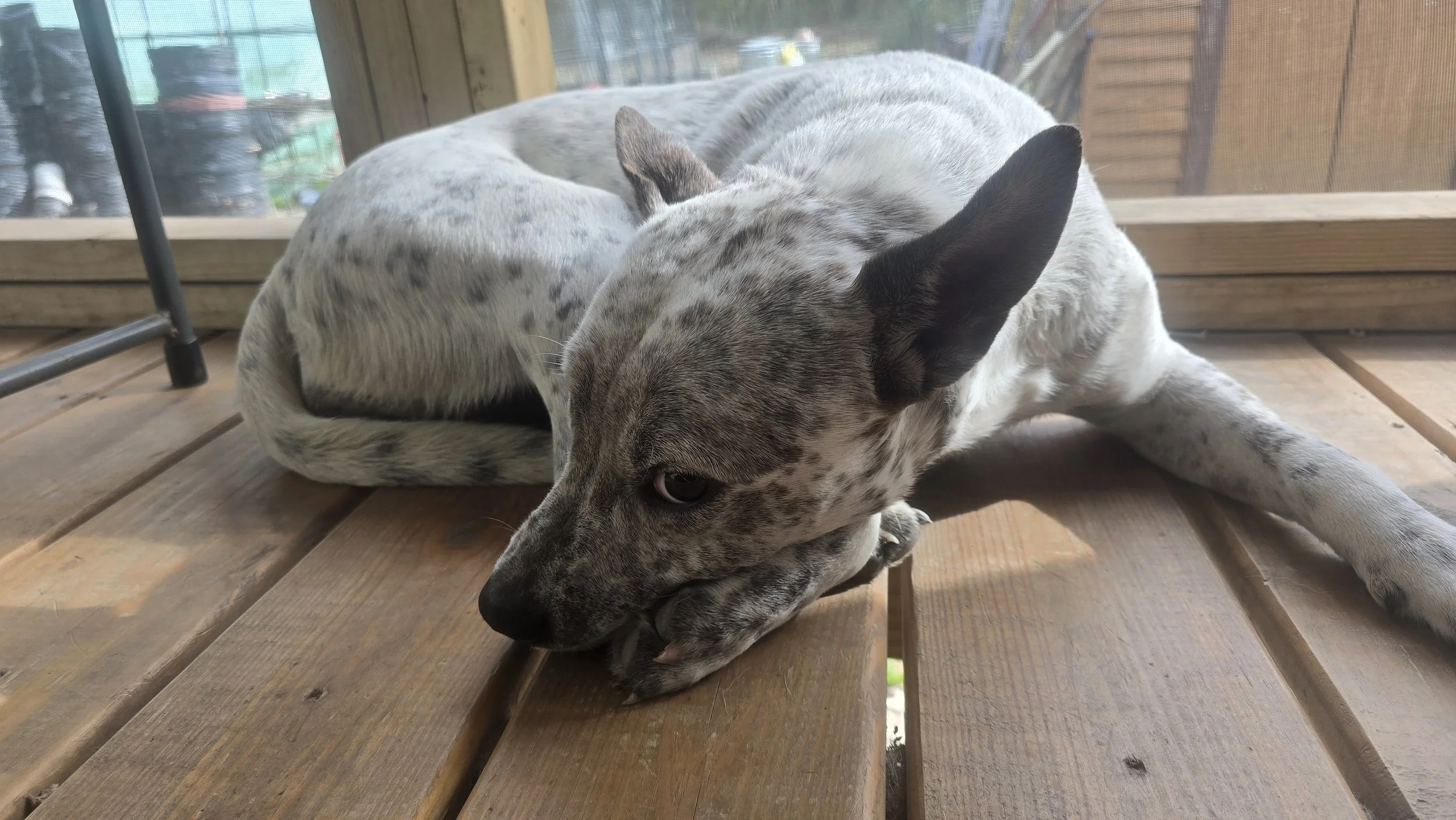
Winter, the unwitting instigator.
I almost lost my thumb the other day.
We currently have nine dogs living in the same home. Among them are a red heeler in heat (Winter) and an uncut blue heeler (Teddy). We do not want them to copulate. Thus, a rigorous routine of shuffling a pack (the rest of whom I will not name, you’re welcome) such that each gets enough yard time.
I’m a glorified prison warden.
This our second time in this less-than-desirable scenario (my fault. Should have got her spayed, but … well, ADHD or whatever excuse is acceptable to you). Mostly it’s just annoying, but it can also be fraught. For example, we have a neutered Australian shepherd (B.B.). He gets to be in the same room as Winter for obvious reasons, and Teddy does not like that.
Tensions escalated over the last week until the porch turns into a version of Big Brother without producers. We were on the cusp of that day. Tell-tale blood drops dappled the porch and Winter’s temper had been flaring over the last few days. When I released Teddy to join B.B. in the pleasant morning air, my brain was screaming, “This is not a good idea!”
Moments later, Teddy circled my chair. A low growl rumbled through him and into my amygdala.
I grabbed his collar.
He snapped at B.B.
B.B. Engaged.
I was stumbling on my knees. My limbs twisted and muscles strained trying to keep them off each other.
Teddy’s jaw latched on B.B.’s face.
I tore them apart, just for B.B. to return the favor.
I shouted, hoping to boost my insufficient strength.
My roommate burst from his room, ready to help.
In the last moments before we separated them, I felt Teddy’s jaw come down on my right thumb.
I mumbled a hurried apology to my boxer-wearing roommate (whose nap had been cancelled) as he grabbed Teddy, extricating him from the brawl, and putting him into his crate.
I assessed B.B. and put him up. Both dogs were fine, but my muscles burned with adrenaline and my knees were scraped to hell. I looked at my right hand, fixating on the small droplet of blood seeping from a hole in my thumb. A quiet ache bloomed around the joint between palm and digit.
I’d come far too close to amputation. I’d felt it coming like spider-man™, and still ignored it.
Why?
Risk v. Empathy
I had documented the spider-sense red flag, and the rejection of it. There must be a reason for that rejection.
In his work Thinking, Fast and Slow,psychologist and Nobel Laureate Daniel Kahneman describes the architecture of decisions, including heuristics, and one latched onto my brain like a dog’s jaw.
"The affect heuristic is an instance of substitution, in which the answer to an easy question (How do I feel about it?) serves as an answer to a much harder question (What do I think about it?)."
I love my dogs and hate to see them confined; I think most people can relate to that. The moment before active thought entered the fray, I wasn’t just experiencing a danger signal from past knowledge, but subconsciously feeling the weight of stealinga beautiful day from my dog.
Isn’t the danger of a dog fight a significantly higher cost than missing some sunshine? Enter cognitive biases, specifically Present bias.
"[P]resent bias refers to the tendency of people to give stronger weight to payoffs that are closer to the present time when considering trade-offs between two future moments (O’Donoghue & Rabin, 1999)."
We discussed a related topic last week with the prominence effect. While both my experiential intuition and my emotional heuristic had costs associated, only the emotional cost was being experienced at present.
The danger was only potential, even if highly likely.
Decisions, Decisions…
This is how real decisions work. They’re messy, and difficult to unravel. Let’s be honest, what I’ve painted for you is, in itself, just a shadow of the platonic ideal of what I experienced in the moment.
What was my mood?
Was my mind occupied with what tasks I needed to complete?
Had I had one too many coffees that day?
There’s not enough paper on Earth to outline a complete proof of a decision, but writers must strive to fold that beautiful complexity into small moments. How can we do that without losing our damn minds? Luckily, we’re part of the centuries’ old tradition of writing, so we don’t have to solve this ourselves.
One method I’ve found particularly useful is Dwight V. Swain’s Motivation-Reaction Units. This article breaks it down well, but you can read this and other approaches in his book Techniques of the Selling Writer. The basic concept is that humans react in predictable, time-bound units after a motivating incident.
Here’s the timeline:
Motivating incident > Feeling (internal, somatic) >Reflexive reaction (external, instinct driven) > Rational action (integration of motivation, feeling, and reflex to make a decision and act)
While my anecdote seems to break this chain, I’ve described it in retrospect with all the magical justification and hindsight that we humans are so skilled in. Zooming into the fractal, we can see the same fissures and familiar curves of the structure.
Motivating incident: “it’s time to let Teddy out.”
Feeling: Intuition says danger, emotions say empathy.
Reflex: a moment of hesitation on my way to the door as intuition warns once more.
Rational action: I chose dangerous empathy.
What v. Why
I’m not giving writing advice, here; I’m certainly not qualified for that. How I understand the world is a function of rational research, and long-term consideration. There are a few short sprints in there too. Living as a human, understanding the science, and critically thinking about story provide vantages to better understand what’s happening.
What we do is important, but why we do it is critical.
For example, if I had been overstimulated, I would have been more likely to choose the option that resulted in the smoothest, most predictable, and quietest alternative. Perhaps more to the point, I may not have even noticed I was dysregulated! How juicy is that for a little irony on the page?
Each method shifts the view, giving me perspective. Next time you’re wondering why you made a choice, or maybe why your character did, remember: in the moment of choice invisible baggage can carry uncanny weight.
And if it is a character, they should probably lose the thumb.
From the Rift,