
Burn Your Art (Somtimes)
Prominence , process, and product
I’ve been an artist my whole life, though most of it I’ve been lying to myself about it. It’s a real shame how good I am at lying.
I talked about my memory gap before fifteen last week. There’s one significant exception to that rule – a series of comics I made. I’m not going to name it as it was back then. Suffice it to say, it was cancel-worthy. Instead let’s refer to it as “Dumboy”
It started with a number 2 pencil and ruled loose-leaf paper, maybe my first steps into improvisation since there definitely wasn’t an outline, and certainly no revision. The plot, if there was one, is lost to me now, but each issue saw Dumboy run and jump off a cliff at least two or three times. As the issues piled up, I decided that one hundred was the right number to aim for.
I sketched furiously, forgoing the ruler. Straight lines were for amateurs. Issue after issue stacked in my binder. Until I wrote 1-0-0. I’d done it. I had finished.
Have you ever finished a creative work? It’s a weird feeling. It’s been a long time since something felt “done” for me. This did, probably because I was too naïve to know what a first draft was. I didn’t understand what “the work” was either. I just knew what a product was, and that I had made one.
When soda fizzed through my backpack, devouring my creation, I was crushed. I beat myself up for not scanning it for posterity. I wouldn’t work on a creative project like that for years.
Not to chastise young William too much, but that was quite a childish view of content creation. Having rejoined the good fight twenty-five years later, I know that it’s full of all different levels of pain, some to overcome, some to endure, and some to leverage.
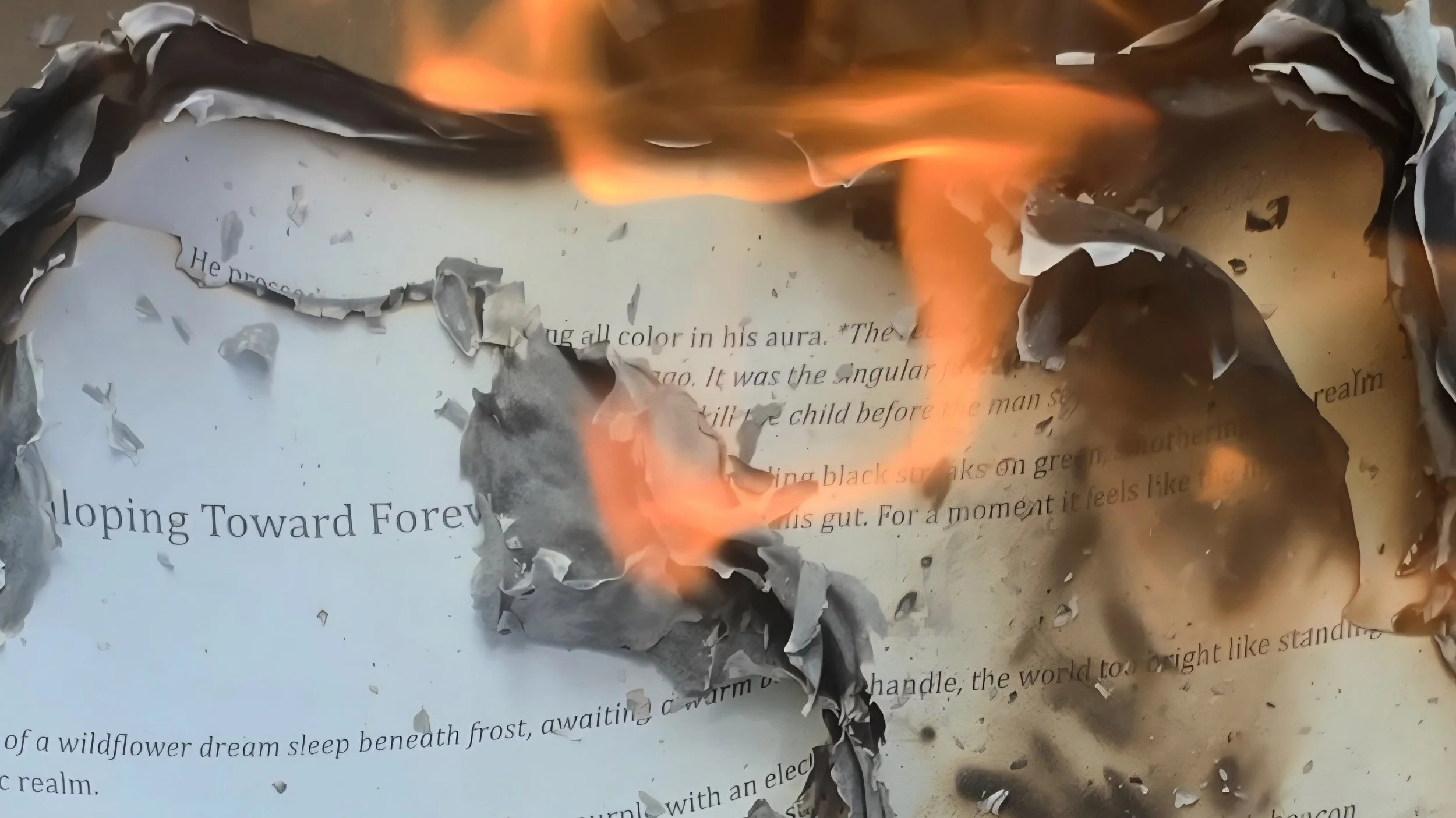
In a congruent moment, I threw out a 60k-word draft of my first novel this time last year (for the morbidly curious, I’ll place a eulogy for Galloping Toward Forever at the bottom of the article). The concept will return, but I don’t think a single word from that piece, which was on its seventh draft, will reappear other than character and location names.
Before throwing it out, I bled into the pages. I cut out organs I considered vital, changed structure, added and removed characters, moved locations, and updated tense and POV. I fought with every breath to “make it work.” Even still, I remember the decision to burn it as when I became a true writer.
Twenty-five years. More than time had passed.
Cardboard and Acrylic
Galloping Toward Forever wasn’t the first piece of my art I’d burned. That happened for a more practical reason. It was shortly after the events discussed in My Personal Delta. I’d stumbled into an opportunity to manage a company in Oklahoma City. Not glamourous, but certainly a step up the success ladder (or, at least, the ladder I sought to climb back then). I stacked cardboard squares with rudimentary acrylic artwork into a cardboard box like a mangled and repurposed matryoshka doll.
Why was I keeping them?
I looked to my bookshelf, filled with tomes I’d consumed and was unlikely pick up again until I packed for the next move. Something in my soul told me they had intrinsic value. Returning to the cardboard in my hand, I still couldn’t answer. It wasn’t intrinsic value, it was a personal weight bound to what would otherwise be trash.
As cinematic as it would be to claim I burned them, I’ll be honest and tell you I placed them into the trash. It wasn’t just the cardboard art, either. I tossed out several small canvas boards I’d played around with as well. I only ended up keeping one piece, a nine-canvas board deep-space painting I’d made with an ex.
That one had a different weight to it, one that had nothing to do with the effort that went into creating the work nor the cost of materials. I deemed it worth keeping because it had transcended from “thing I made” into a coded memory.
As for the cardboard, I mostly just feel bad that I coated a biodegradable medium with acrylic ink, but we all make mistakes.
Prominence in POV
Essays are funny. You explore an idea, do some research so you don’t make an ass of yourself, and end up learning something. I dove into the prominence effect[1], hoping to give y’all a juicy article to impress your armchair academic friends. Instead, I’m holding a scientific frame for my anecdotal experience.
I love science. Not just the learning part, but the struggle of it. Reading a sentence three or four times because you know there’s something there worth understanding. This is, of course, after you’ve read a bunch of sentences you either didn’t understand at all or were irrelevant to your query, or, worst of all, rigorous procedure.
Here’s the sentence that got me:
What was prominent with Dumboy? Having finished something. It was proof that I could do it. The loss was sudden and sharp.
How about the cardboard on acrylic? That was discovery. Each piece, a footstep in the sand, meant to be washed away.
Galloping Toward Forever is a forged link in the chain of my craft. It’s there, even after I threw it away.
Art takes a certain level of obsession. You can call it dedication if you like, but that’s just a more socially acceptable term. Whether writing, painting, dancing, or otherwise, art is deeply personal and often isolating .
Maybe that’s why I fall in love with my pieces. I kind of have to. Only some of artists get lucky enough that other humans will actively enjoy our work sometime down the line, and it’s even rarer to get genuine interaction.
That puts me in a bit of a quandary, doesn’t it? In order to do the work, I have to be obsessed. To be obsessed, is to narrow my gaze. Prominence becomes importance through the alchemy of behavioral psychology.
I’m not arguing against that connection. It’s vital. It’s what allows me to transfuse my work with my experience, and to gain new understanding about the world and myself.
I am suggesting that we need to burn our art.
… Sometimes
It’s still a struggle for me. It’s easier with words than with illustrations. Well, some illustrations. The crap ones are easy to throw into the sun or oncoming traffic. The inhuman things I’ve drawn could fill a child’s closet.
The ok ones, the not-quite right, the “you know this isn’t good enough.” Those are harder to throw away. As I stare at those creations, after the spike of frustration lights my veins, I try to remember the cardboard acrylics. The footsteps.
I can’t recall a single line or color, but I’m still walking on the same beach.
Occasionally, when I love something just a bit too much, I’ll pick up some driftwood art and build a fire.
From the Rift,
P.S.
As promised, here’s the original pitch for Galloping Toward Forever:
In a world where psychic power flows through all living things, two souls were meant to be fused into one. Beauford is a psychic warhorse. Zebethy, a calculating demon. Together, they were meant to become a single time-traveling assassin. Their mission was to turn the tide of the horse wars, by killing the boy who would invent a psychic weapon that enslaves horse kind. But the ritual fails. Beauford wakes in a frontier town with only fragments of memory and a mission he no longer fully understands. Flung fifteen years earlier, Zebethy begins to unravel in solitude—obsessed with the boy who carves the whistle they were meant to destroy. Separated, disoriented, and convinced the other is dead, they walk diverging paths toward the same inevitable end.
[1] "[The Prominence Effect] refers to our tendency to give undue attention to certain aspects of a situation or decision, often at the expense of other important factors.”
Prefer to listen? Subscribe on Apple Podcasts, Spotify, or using the RSS feed
