
On Winning Monopoly
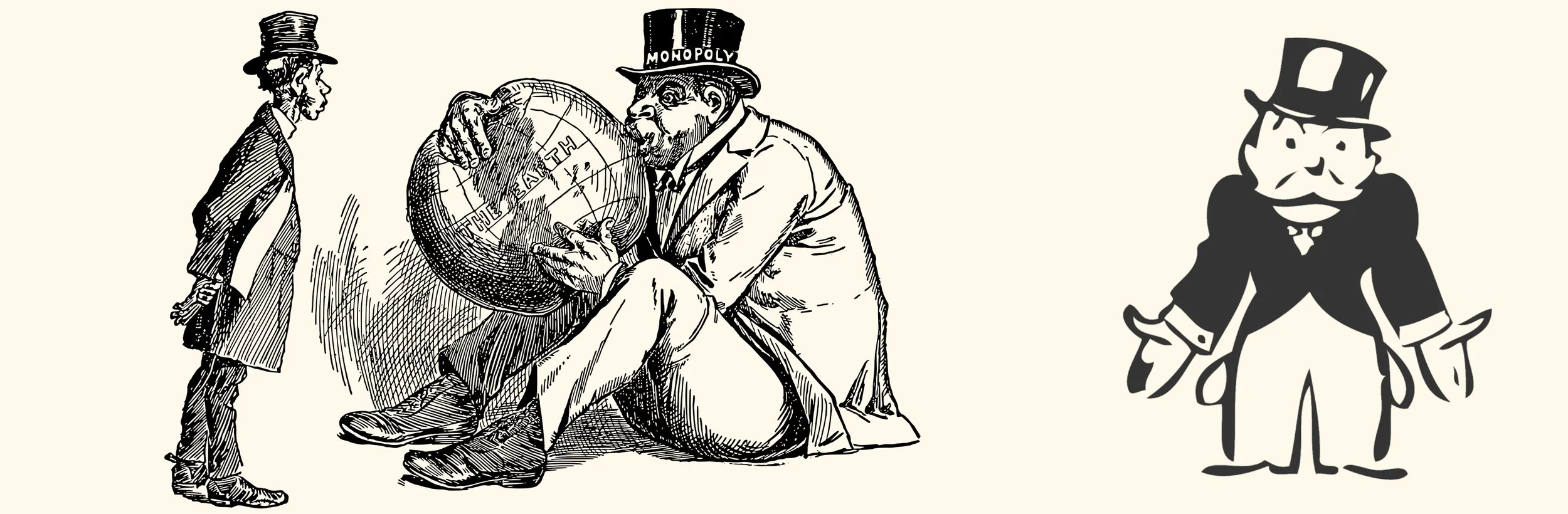
Sometimes I wonder if my choice to live out in the country is just one more revolt against Monopoly.
Not the economic phenomenon. I’m not foolish enough to think that I could influence one of those behemoths. No, I’m talking about the boardgame, and while it would be perfectly reasonable for you to point out that I’m unlikely to affect that either, it would be equally reasonable for me not to hear you – since I’m nowhere near you. Because I’m in the country.
Monopoly sucks. The smiling snake-oil salesman on the cover should make it obvious and if that wasn’t enough of a clue the game forces one person to do accounting. No offense to the accountants who enjoy accounting, but you know you’re in the minority, right? The experience tests the bounds of what could be considered a “game.” The worst part, though, was unanticipated and isn’t even part of the rules.
This game turns people evil. I’m serious.[1]
“The dirty trick is that when you’re winning, it always feels like you deserve it.”
Have you ever been in the winning position in a game of Monopoly? I don’t mean finishing as winner, we’ll get to that in a minute, I mean winn-ing. I become someone I don’t recognize. It’s one of the most distinct feelings of the human experience, for me.
There’s this tingling giddiness, like I know a joke that no one else can even understand and somehow that makes the joke better. One can hardly contain one’s self when “negotiating” a deal at which you sit in the higher chair. It’s not that everyone else is a fool, they just made wrong choices, while you made all the right choice.
Well, not all the right choices surely. We all make mistakes. What matters, though, is you persevered – you made it! Even when the colorful bills were few and far between (perhaps there was a point in the game where you had only double the funds of the other players) you looked the devil right in the eyes and didn’t blink.
Maybe that’s what’s so funny.
The experience is as delightful and rewarding as the morning after two bottles of champagne.
What’s worse is it’s not really a game at all, it’s an allegory, and a truly unfortunate one. That’s what pisses me off: Monopoly proves that I’m just as bad as everyone else, and we’re all kind of shitty.
Every once in a while, life gives you a little hope that we might not be so bad. For example, did you know that the Standford Prison experiment was falsified? Yep. The profession instructed the students in position of guard to be cruel, they just listened. Turns out, we aren’t all bastards when given complete and total authority over helpless others. Sure, they did listen, so they’re not entirely off the hook, but it’s better than a choice, right? Finally, proof we aren’t shitheads.
Then Monopoly returns with a boring yet consequential Shamalan twist.
In an experiment with decidedly lower stakes, Paul Piff used Monopoly instead of Guantanamo as the stage. Rather than authority, some participants are given advantage – 30% more starting cash, double the dice, and twice the money when passing go.
At this point you may notice that the scenario sounds all too familiar to reality, but let’s just ignore than rather disturbing and unpleasant fact and move on.
Obviously, the players with the advantage won the game, there’s no surprise there. What’s interesting is the arrival of what I like to call the “infinite justification loop.” When asked how they won, those with the starting advantage shrugged and replied, “I played the game better.”
Around 80% of the “rich” participants credited their win to their own skills. “I invested wisely in real estate,” they’d say, forgetting that their starting cash let them buy properties without risk. The poorer players, by contrast, were more likely to mention luck or inequality: “He had way more chances from the start.” - The aforementioned study
Man, don’t those poor players sound like a bunch of whiners? If they want someone to listen, they’d better have something more convincing that objective reality.
It’s not that surprising for anyone who’s talked to a successful person. It’s rare indeed, and quite undesirable, for a wealthy or successful individual to admit that they did not achieve their laudable heights from will power, intellect, and their more developed frontal lobes alone. Doing so is akin to dropping the f-bomb in front of your WASPy grandma.
That would be bad enough, but when I played as a kid, no one had a leg up. One could argue the more developed minds in the game did, but that hardly counts. The dirty trick is that when you’re winning, it always feels like you deserve it. You conveniently forget the place of gravity and the manufacturing quality of the dice. You forget winning second place in a beauty contest.
But you remember the shrud choices, the clever deals, the risks that paid off.
What is it inside us that justifies the validity of our high-standing at a certain point? Is there a specific height at which the pedestal begins to feel “earned”? I wish I had answers for you, but I’m just trying to keep from turning into Mr. Hyde if I can.
Life isn’t a game, but some have the luxury to treat it like one. Things have a way to turning into what we pretend they are. Maybe that’s part of why I blew up my life, threw away the white-collar future, and picked up a shovel.
I guess it wasn’t hate that drove me to the country, it was more out of a need to preserve reality. Still, the game sucks.
From the Rift,

[1] I’m not serious
Thanks for Reading!
Prefer to listen? Subscribe on Apple Podcasts, Spotify, or using the RSS feed
